High-Performance Wireless Studio & Consumer Audio Equipment
Factory-direct wireless monitors, true wireless earbuds, high-fidelity receivers, and customizable audio hardware for brand owners and global distributors.
Executive Summary: The Evolution of Wireless Studio Headphones & OEM Sourcing Standards
The global professional audio market is undergoing a structural transition. Traditionally, professional audio monitoring required wired tethering to eliminate transmission latency, signal compression, and phase distortion. However, advancements in uncompressed Bluetooth codecs (LDAC, aptX Lossless, LC3), combined with proprietary 2.4GHz ultra-low-latency RF protocols, have empowered top wireless studio headphones suppliers to achieve uncompromised studio-grade audio transmission over wireless links.
For B2B procurement managers, brand owners, and OEM/ODM sourcing directors, evaluating a wireless studio headphones factory requires analyzing parameters far beyond standard consumer specs. True studio monitoring demands flat frequency response profiles, ultra-low total harmonic distortion (THD < 0.5%), mechanical ergonomics capable of enduring 8+ hour mixing sessions, and robust electromagnetic shielding.
Strategic Sourcing Insight: Premium studio monitoring headphones require high-density neodymium magnet dynamic drivers (40mm to 50mm) or planar magnetic arrays coupled with dual-engine DSP chips. Partnering with a supplier capable of custom acoustic tuning and firmware flashing ensures compliance with strict audiophile and broadcast monitoring requirements.
Key Technical Milestones in Modern Wireless Audio Manufacturing
High-Resolution Wireless Audio Transmission: Native 24-bit/96kHz wireless data streaming utilizing LDAC technology (transmitting up to 990 kbps) eliminates standard SBC Bluetooth compression bottlenecks.
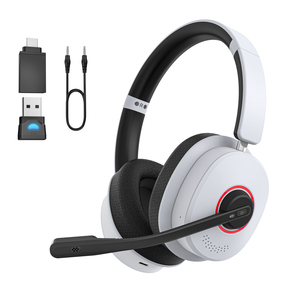
Ultra-Low Latency Tri-Mode Connectivity: Seamless switching between 2.4GHz ultra-low latency wireless dongles (<15ms response time), Bluetooth 5.3/5.4, and wired 3.5mm/6.35mm gold-plated bypass inputs for real-time tracking and zero audio-video delay.
Advanced Hybrid Active Noise Cancellation (ANC): Dual-feedforward and feedback microphone arrays achieving -45dB to -52dB acoustic isolation, allowing audio engineers to mix in non-treated ambient environments without sound bleed.
Enclosure Acoustics & Material Science: Precision-milled acoustic chambers utilizing high-rigidity ABS composites, protein memory foam ear pads, and food-grade silicone seals to prevent acoustic resonance and microphonic cable interference.
OEM/ODM Specifications Benchmark Matrix for Wireless Studio Audio
When placing enterprise B2B purchase orders or initiating custom ODM production lines, acoustic hardware metrics must be benchmarked against industry standards. The table below outlines the core technical specifications verified across tier-1 audio manufacturing factories:
Specification Category
Commercial Grade Headphones
Professional Wireless Studio Monitors
Factory OEM Customization Capability
Driver Configuration
30mm - 40mm Mylar / PET Diaphragm
40mm - 50mm Titanium/Beryllium Dynamic or Planar Magnetic
Custom diaphragm coating, voice coil impedance tuning (32Ω to 250Ω)
By leveraging integrated R&D facilities, leading manufacturers allow brand partners to adjust driver damping, headband clamp force (N-force tuning for multi-hour session comfort), and custom plastic injection tooling to meet targeted market price points without sacrificing structural durability.
Future Procurement & Technological Trends in Wireless Studio Audio (2025–2030)
Strategic B2B sourcing decisions require forecasting technological shifts to prevent product obsolescence. In the rapidly changing wireless audio landscape, several key engineering trends are redefining how global brands source studio monitoring hardware from original equipment manufacturers:
1. Bluetooth LE Audio & LC3 Codec Standardization
The standard adoption of Low Energy (LE) Audio and the LC3 (Low Complexity Communication Codec) provides superior audio quality at less than half the bitrate of traditional SBC, drastically reducing power consumption and chip thermals during long studio tracking sessions.
2. On-Headset AI Spatial Audio Tracking
Integration of 6-axis IMU (Inertial Measurement Unit) gyroscopes and accelerometers embedded directly into the headset frame allows real-time binaural spatial rendering. Studio monitors can now track head movements to simulate acoustic studio room environments dynamically.
3. Modular Hardware & Sustainable Manufacturing
Global regulatory bodies (such as EU Right-to-Repair directives) are driving demand for modular wireless studio headphones. Factories are transitioning to magnetic replaceable ear pads, toolless detachable lithium batteries, and post-consumer recycled (PCR) plastics.
Supply Chain Optimization: Risk Management & Quality Control
Enterprise buyers sourcing from top wireless studio headphone factories must enforce stringent Quality Assurance (QA) and Quality Control (QC) protocols throughout the supply chain. Key operational checkpoints include:
Acoustic Matching & Driver Pairing: Ensuring left/right driver tolerance within ±0.5dB across the entire 20Hz - 20kHz spectrum using automated SoundCheck or Audio Precision (AP) test benches.
RF Signal Interop & Stress Testing: Testing 2.4GHz and Bluetooth signal stability in high-density 2.4GHz interference environments to prevent audio dropout during live broadcasting.
Environmental Resilience & Hinge Fatigue: Conducting 10,000+ cycle headband stretch tests, drop tests from 1.5 meters, and IPX4/IPX8 water-resistance chamber validation for sweat and outdoor moisture resistance.
Enterprise Advantages: Why Top Global Audio Brands Partner With Us
With registered R&D facilities established since 2015 and an expansive global user base exceeding 30 million listeners, our manufacturing ecosystem provides an end-to-end infrastructure engineered specifically for B2B distributors, OEM partners, and enterprise brand builders.
Core OEM/ODM Manufacturing Strengths
Comprehensive IP & Patent Portfolio: Backed by over 200 international patents, our acoustic, structural, and wireless software solutions ensure your brand operates with full freedom to operate (FTO) protection in North America, Europe, and Asia-Pacific.
International Design & Industry Recognition: Products built across our manufacturing framework have consistently earned prestigious honors, including MUSE Design Awards Gold, International Design Awards (IDA), and CES Innovation Recognition.
Vertically Integrated Supply Chain: From high-precision SMT surface-mount technology for PCB assembly to dedicated injection molding and automated acoustic calibration lines, vertical integration reduces tooling lead times by up to 35%.
Strict Compliance & Global Certification: All production runs conform to ISO9001 quality management standards and BSCI social compliance, fully certified for CE, FCC, RoHS, REACH, and Telec regional distribution.
Frequently Asked Questions (FAQ) for Global B2B Audio Procurement
Find answers to common questions regarding minimum order quantities (MOQ), custom OEM acoustic tuning, production lead times, and warranty fulfillment protocols.
What is the standard Minimum Order Quantity (MOQ) for OEM/ODM studio headphones?
For standard catalog models with customized logo printing and branded packaging, our typical minimum order quantity starts at 500 to 1,000 units per batch. For full ODM custom tooling projects (including custom plastic molds, proprietary acoustic chamber development, and bespoke PCB layout engineering), the base MOQ is generally 3,000 to 5,000 units depending on components.
Can the factory tune frequency response curves to match proprietary target sound profiles?
Yes. Our acoustic engineering department operates fully equipped anechoic testing chambers and Audio Precision (APx555) analyzers. We can tune sound signature targets—whether your brand requires a Harman Target Curve, a completely flat diffuse-field sound profile for studio mixing, or a bass-emphasized curve for gaming—directly through onboard DSP hardware and acoustic driver dampening adjustment.
How are low-latency requirements guaranteed for wireless monitoring applications?
To achieve sub-15ms audio latency required for real-time instrumental tracking and studio recording, we integrate dual-chip solution sets combining low-latency 2.4GHz RF transmitters (USB-C/USB-A dongles) alongside high-bandwidth Bluetooth 5.3/5.4 silicon. This tri-mode approach guarantees ultra-fast transmission without lip-sync delay or tracking latency.
What quality certification standards apply to international shipments?
Every product manufactured within our partner facilities undergoes rigorous international compliance testing. Standard certifications include CE, FCC, RoHS, REACH, WEEE, and TELEC. Battery packs are fully compliant with UN38.3, MSDS, and IEC 62133 safety standards, ensuring smooth customs clearance across North American, European, and Asian markets.
What are the standard production lead times from golden sample approval to mass delivery?
Once pre-production golden samples are approved: standard OEM repeat orders require 25 to 30 days for mass assembly and burn-in testing. Initial custom ODM orders requiring customized tooling, chip firmware development, and international lab certification typically range from 45 to 60 days.
What after-sales and warranty support structure is provided for enterprise partners?
We provide comprehensive warranty terms (typically 12 to 24 months depending on contract tier) covering structural defects and internal electronic component failures. Spare part allocation (such as extra ear pads, detachable cables, and dongles) can be bundled directly with bulk container shipments to streamline local customer service fulfillment.
Partner With a Premier Wireless Studio Headphones Factory
Scale your audio product line with custom OEM/ODM manufacturing, high-resolution wireless technology, and market-proven acoustic engineering. Request engineering specs, factory audit reports, and pricing quotes today.